
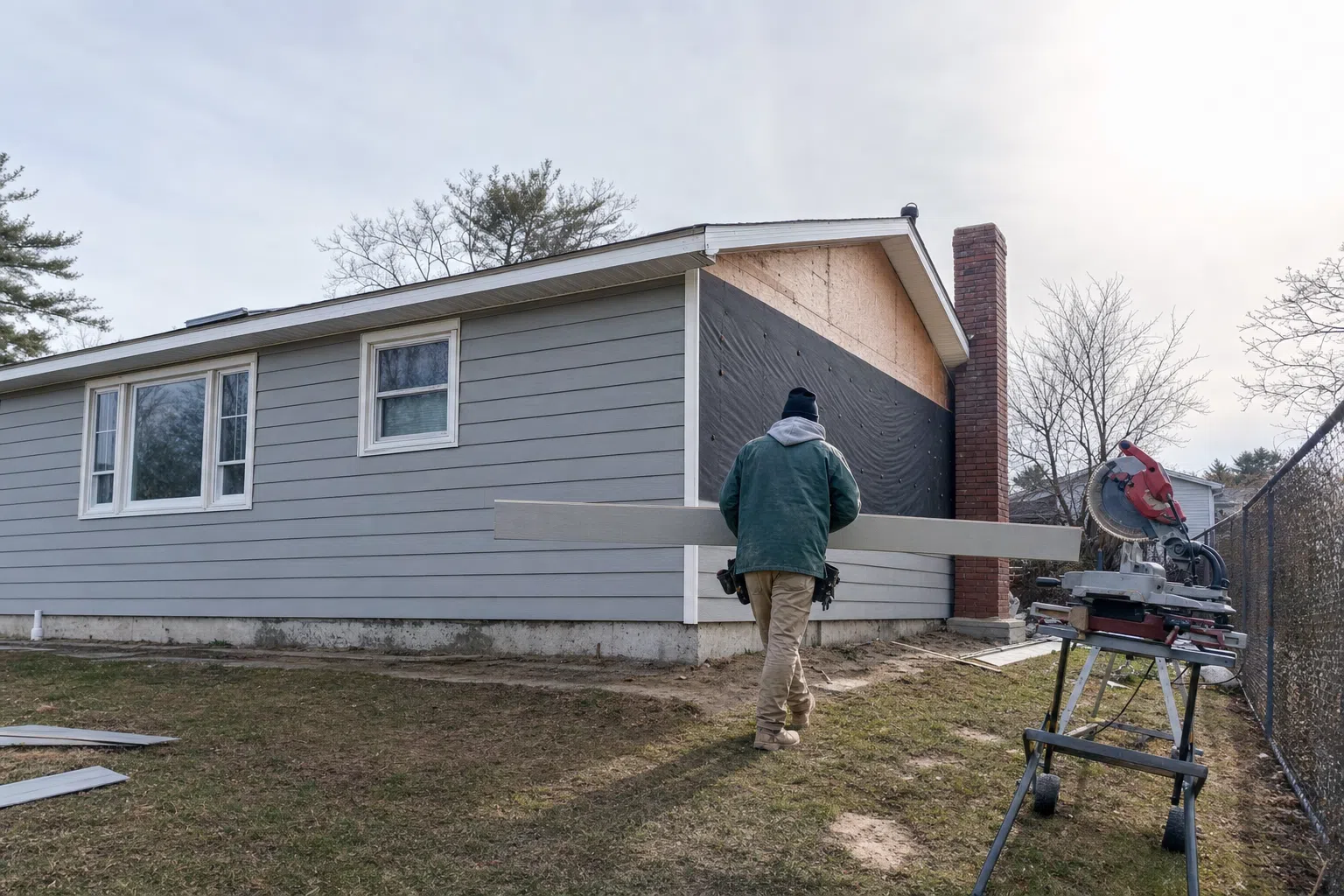
Hardie board siding is what most people call fiber cement, and out here it is the material I get asked about most. The question is always some version of the same thing. Does it actually hold up on Long Island, with the salt, the wind, and a nor’easter every couple of winters.
The short answer is yes. The longer answer is that it holds up when it is installed right, and it is less forgiving of a sloppy install than vinyl is. Almost every fiber cement failure I get called out to look at is an install problem rather than a product problem.
The quick version: fiber cement handles salt air and wind better than wood or vinyl. It needs stainless fasteners near the water, real clearances at the ground and the roof, every cut end sealed, and proper flashing at the windows. It also needs repainting eventually unless you buy it factory finished.
What Hardie Board Actually Is

Fiber cement is cement, sand, and cellulose fiber pressed into a plank. That mix is the reason it behaves the way it does. It does not rot, insects have no interest in it, and it does not melt or feed a fire the way a wood or vinyl product can.
It is also heavy. A plank weighs several times what a vinyl panel of the same size weighs, which makes it a two-person hang and slows the crew down. That weight is part of why the labor line on a fiber cement quote is higher than the vinyl one. It is also part of why it stays flat on the wall for decades.
Cutting it releases silica dust, so a real crew uses shears or a saw with dust collection and wears respirators. If you see somebody free-cutting fiber cement with a standard circular saw and no mask on your property, that tells you something about the rest of the job. Everything in this post applies to any fiber cement product, which is what our fiber cement siding installation work covers.
How Salt Air and Wind Actually Treat It

The board itself handles salt air well. It does not corrode, and it does not soak up moisture and swell the way wood siding does. On a house within sight of the water, the two things that go first are the fasteners and the paint film, and both of those are choices somebody made during the install.
Within a couple of miles of the water we use stainless steel nails, not galvanized. Galvanized fasteners will start rusting in that air and the rust bleeds down the face of the siding. You cannot fix that later without pulling boards, so it is one of the few decisions that is genuinely permanent.
Wind is where fiber cement really pulls ahead. It is heavier and stiffer than vinyl, it is nailed into studs rather than hung on a nailing hem, and it does not unzip in a gust. What still needs attention is wind-driven rain, because rain moving sideways gets behind any siding on the market. That is a job for the water barrier and the flashing underneath, and it is covered further down.
What the Install Has to Get Right

This is the list I would hand a homeowner comparing two quotes. If a contractor cannot talk through these without hesitating, keep looking.
- Clearance at grade, meaning the bottom course sits well above soil, mulch, or a walkway rather than touching it
- Clearance where the siding meets a roof, a deck, or a set of steps, which gets missed more often than the ground clearance does
- Blind nailing into studs at the correct spacing, with nails set flush and not driven through the face of the board
- Butt joints landing over a stud with a joint flashing behind them, never over open sheathing
- Every field-cut end primed or sealed the same day it is cut, before it goes on the wall
- Kick-out flashing where a roof line runs into a wall, which is the single most common thing missing on houses we strip
- A gap at trim and corner boards that gets sealed, rather than boards jammed tight against the trim
- Sealant used where it belongs and not smeared along the horizontal laps, which are supposed to shed water and breathe
That list is most of the price difference between two fiber cement quotes on the same house. The boards cost what they cost. Whether somebody flashes a butt joint and seals a cut end is labor, and labor is where a cheap number comes from. We estimate every project down to the nail and put those items on the sheet as their own lines, so you can see what you are getting instead of comparing two totals.
Primed and Painted On Site, or Factory Finished

You can buy fiber cement two ways. Primed, which means it gets painted on site after it is hung. Or factory finished, which means the color is baked on at the plant before it ships.
Factory finish costs more up front and the coating lasts noticeably longer, especially on a wall that gets afternoon sun off the water. Field painting costs less up front and you will be repainting sooner. There is a practical trade-off too. Field paint is easy to touch up because you keep a can of it. Factory finish is harder to match on a repair, so you order a few extra planks and keep them in the garage.
Either way, cut ends get sealed. That is not optional on a coastal house. Fiber cement holds paint better than wood does because it barely moves with temperature and humidity, so the paint film is not being stretched every season. That is a real part of why the repaint interval is longer.
What Actually Goes Wrong on Long Island Houses

When I get called to look at a fiber cement problem, it is almost never the board. It is water that got behind the wall somewhere and had nowhere to go. Missing kick-out flashing at a roof-to-wall joint. Windows flashed in the wrong order. Siding buried in mulch that a landscaper piled up two inches a year for a decade. Cut ends that were never sealed, sitting right where water runs off a sill.
By the time it shows on the outside it has usually been going on a while. Water that gets behind siding shows up inside the house first, and people read it as something else. A soft spot in the drywall under a window. A bathroom wall that feels damp behind the tile. A floor that gives a little near an exterior wall.
We handle both ends of that repair, which is why our bathroom remodeling smithtown work and our kitchen remodeler port jefferson station work run out of the same office as the siding crews. When we open a wall from the outside and find the damage went inside, you are not hiring a second contractor and waiting three weeks to start over.
How It Compares to What Else You Are Considering

Most homeowners out here are choosing between four things. Here is how they line up on the questions that matter within a few miles of the water.
| Siding | Salt and wind | Upkeep | Worth knowing |
|---|---|---|---|
| Fiber cement | Handles both well, does not rot or corrode | Repaint roughly every 10 to 15 years unless factory finished | Heaviest and slowest to install, which raises the labor line |
| Vinyl | Fine with salt, can come loose in high wind if nailed wrong | Rinse it, nothing to repaint | Cheapest option, can fade on sun-facing walls and crack in deep cold |
| Engineered wood | Good, as long as every cut end is sealed | Repaint roughly every 8 to 12 years | Lighter and faster to hang than fiber cement, so labor costs less |
| Cedar | Takes the most punishment from salt and sun | Stain or paint every 4 to 7 years | Best looking of the group and the most work to keep that way |
If you are planning to stay in the house fifteen years or more and you are close to the water, fiber cement is usually the one I point people toward. If you are selling in five, the math changes and vinyl is a reasonable answer.
If you want the whole field laid out side by side, our types of siding has it.
Have Somebody Look at the Wall First
Before you price siding, it is worth having somebody walk the house and look at the roof-to-wall joints, the window heads, and how close the current siding sits to the ground. Those three spots tell you most of what you need to know about whether this is a straight replacement or whether there is repair work underneath.
Send us the address and a few photos through our contact form and we will come out and look. You will get an itemized estimate down to the nail with the flashing, the wrap, the fasteners, and the labor broken out as their own lines, and no fees that appear later. Once the job starts you get a portal with daily logs and a live schedule so you know who is at the house and what they are doing.